def make_demo_adata(seed=7):
    """
    Simulates 5 samples with different temporal patterns in gene expression.

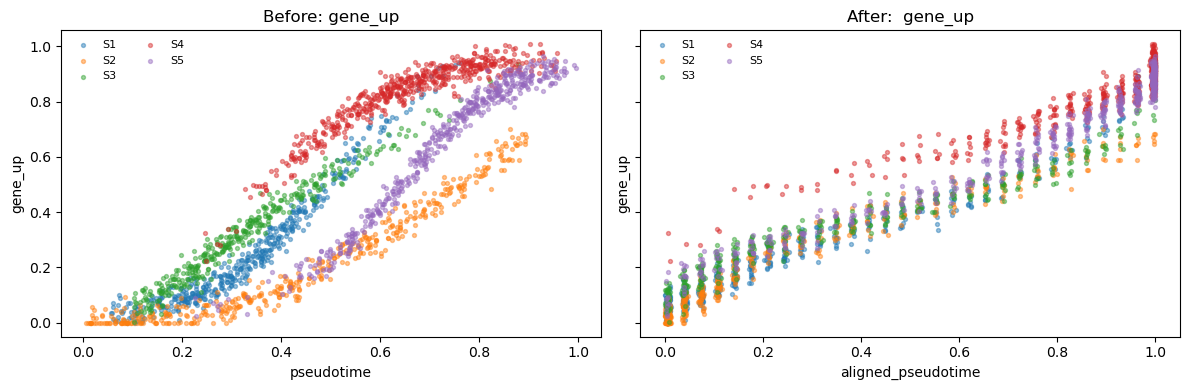
    - gene_up: a sigmoid function that increases from 0 to 1 as the canonical time increases
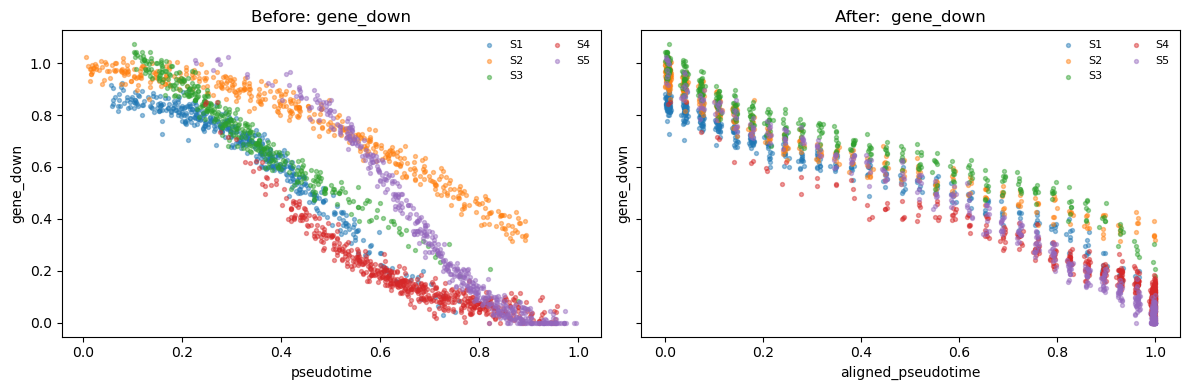
    - gene_down: a sigmoid function that decreases from 1 to 0 as the canonical time increases
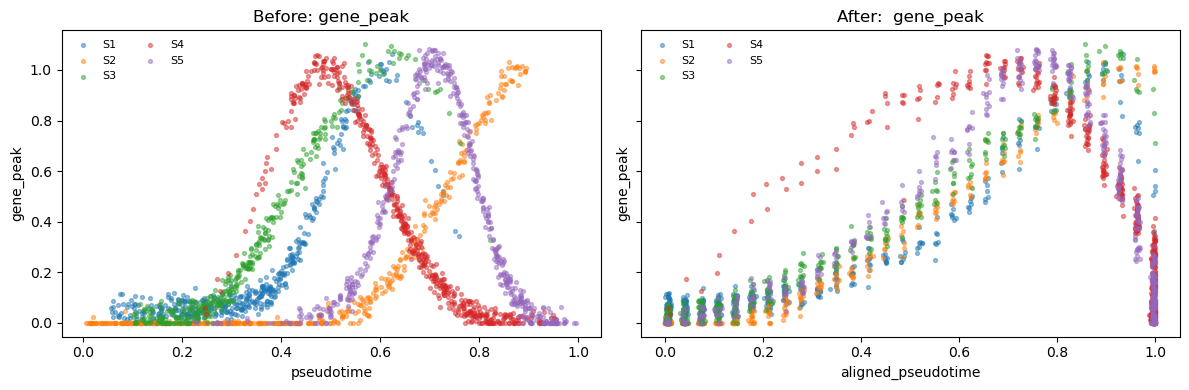
    - gene_peak: a Gaussian function that peaks at a specific canonical time
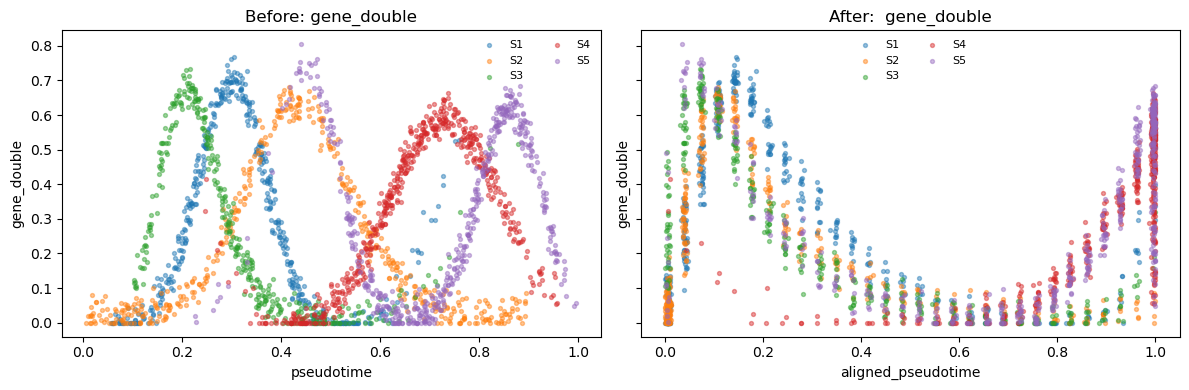
    - gene_double: a combination of two Gaussian functions that peak at different canonical times
    """
    rng = np.random.default_rng(seed)

    # ----- gene programs on canonical time u in [0,1]
    f = {
        "gene_up": lambda u: 1 / (1 + np.exp(-8 * (u - 0.5))),
        "gene_down": lambda u: 1 / (1 + np.exp(8 * (u - 0.5))),
        "gene_peak": lambda u: np.exp(-((u - 0.6) ** 2) / 0.02),
        "gene_double": lambda u: 0.7 * np.exp(-((u - 0.3) ** 2) / 0.01) + 0.6 * np.exp(-((u - 0.8) ** 2) / 0.015),
    }
    genes = list(f.keys())

    # ----- sample-specific monotone warps (nonlinear)
    warps = [
        lambda t: t,
        lambda t: np.where(t < 0.5, 0.7 * t, 0.35 + 0.6 * (t - 0.5)),  # slow→fast
        lambda t: np.clip(t + 0.08 * np.sin(2 * np.pi * t) + 0.1 * t * (1 - t), 0, 1),  # smooth S
        lambda t: t**0.7,  # late dilate
        lambda t: t**1.5,  # early dilate
    ]
    samples = [f"S{i + 1}" for i in range(len(warps))]
    n_per = [450, 500, 400, 520, 480]  # uneven cell counts
    betas = [(3, 6), (1, 1), (2, 5), (6, 3), (5, 2)]  # Beta densities
    crops = [(0.05, 0.95), (0, 0.9), (0.1, 1), (0, 1), (0.15, 1)]  # partial overlap

    X_list, obs_list = [], []
    for sid, warp, (a, b), n, (lo, hi) in zip(samples, warps, betas, n_per, crops, strict=False):
        t = np.sort(rng.beta(a, b, size=n))
        t = t[(t >= lo) & (t <= hi)]  # crop to simulate partial overlap
        u = warp(t)  # canonical time (ground truth)
        amp = rng.normal(1.0, 0.05, len(genes))  # per-sample gene amplitude
        base = rng.normal(0.0, 0.03, len(genes))  # per-sample baseline
        expr = np.vstack(
            [np.maximum(amp[j] * f[g](u) + base[j] + rng.normal(0, 0.03, len(t)), 0.0) for j, g in enumerate(genes)]
        ).T
        X_list.append(expr)
        obs_list.append(pd.DataFrame({"sample": sid, "pseudotime": t, "canonical_time": u}))

    X = np.vstack(X_list)
    obs = pd.concat(obs_list, ignore_index=True)
    var = pd.DataFrame({"gene": genes}).set_index("gene")
    return AnnData(X, obs=obs, var=var)


# Create the dataset for your demo notebook
adata = make_demo_adata()